

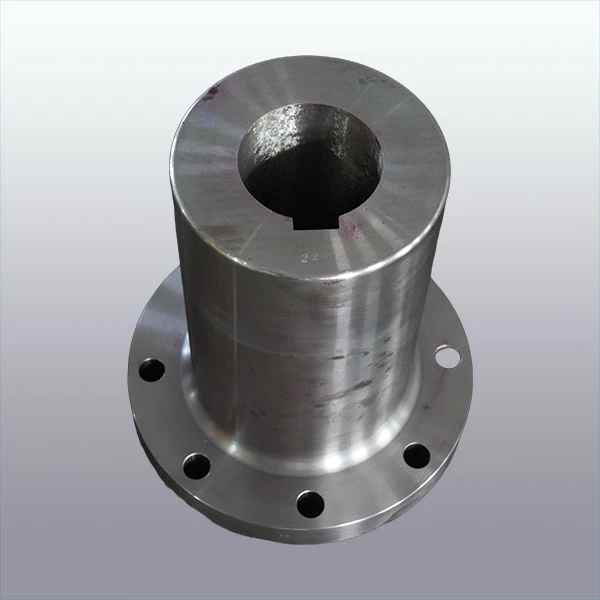
Products Description
Boat Shaft Couplings are core components for marine power transmission, consisting of two coupling halves and connecting parts. They are connected to the shaft segments via keys and bolts, transmitting torque and ensuring stable power output. Marine Stern Shaft Couplings are installed at the stern and are forged from high-strength alloy steel. They are hard-chrome plated or spray-coated for corrosion resistance, and feature built-in rubber bushings or metal bellows to absorb vibration. Propeller Shaft Marine Couplings are fastened with high-strength bolts, some featuring centering adjustment devices and seals to ensure coaxiality and prevent seawater intrusion. They are widely used in marine shafting connections.
Working Principle and Core Functions
Boat shaft couplings play multiple key roles in a ship's power transmission system:
Serving as the power transmission bridge between the engine and propeller, they efficiently transfer the engine's rotational power to the propeller, propelling the ship forward.
Utilizing elastic elements or specialized structures, they absorb and cushion transient overloads generated by engine startup, speed changes, and wave impact, protecting the main engine and transmission system.
Compensates for shaft misalignment caused by hull deformation, temperature fluctuations, or installation errors, reducing bearing wear and shaft vibration.
Marine stern shaft couplings, in particular, effectively isolate propeller vibration from being transmitted to the hull, reducing underwater radiated noise.
Some couplings are designed with overload protection, causing them to slip or disconnect when the torque exceeds a set value, preventing damage to critical equipment.
Key Features and Advantages
1. Excellent Torque Transmission:
Designed specifically for high-power ship propulsion systems, it reliably transmits the massive torque generated by diesel engines or turbines, ensuring propulsion efficiency.
2. Excellent Misalignment Compensation:
Effectively compensates for axial, radial, and angular misalignment caused by hull deformation, thermal expansion, and installation errors, protecting bearings and shafting.
3. Excellent Vibration Damping:
Specifically designed to isolate and attenuate torsional vibrations generated by diesel engines and impact vibrations from propellers, preventing vibration transmission to the ship structure and improving ride comfort.
4. Strong Corrosion Resistance:
Manufactured from special stainless steel, bronze, or galvanized steel, and equipped with a special marine-grade anti-corrosion coating, it resists corrosion from seawater and salt spray.
5. High Reliability and Safety:
Designed to comply with the requirements of major classification societies, ensuring long-term reliable operation in harsh sea conditions.
6. Easy Maintenance:
Many modern ship couplings feature maintenance-free or low-maintenance designs, minimizing ship downtime and reducing operating costs.
Installation and Maintenance Key Points
Proper installation and maintenance are crucial to ensuring the long-term, reliable operation of your boat shaft coupling:
Accurate Alignment: During installation, ensure that the shaft system is aligned within the permitted range.
Standard Installation: Strictly follow the manufacturer's installation instructions.
Regular Inspection: Establish a regular inspection system, including visual inspection, bolt tightening checks, and alignment checks.
Monitoring: Vibration and temperature monitoring are recommended for critical parts.
Management: Maintain an appropriate number of critical spare parts to minimize downtime


