

Coupling
Your Professional Coupling Supplier
Wuxi Junzhi Machinery Equipment Manufacturing Co., Ltd. (formerly known as Wuxi Yaqing Machinery Factory) was founded in the early 1990s.
The company specializes in the production of key mechanical components, with flagship products primarily including marine shafting systems, marine rudder components, propeller shafts, agitator shafts, and other related equipment.


why choose us
High Quality
Our factory strictly follows the GB/T9001-2008 quality system standard, continuously promotes product iteration and upgrades, and is committed to meeting and exceeding customer expectations.
Professional Team
After years of continuous progress and development, the factory has successfully trained a group of workers and technical teams with both high literacy and professional skills.
24-Hour Service
24-hour exclusive online customer service, quick response, accompany you to excellent shopping, and strive to create an excellent shopping experience for you. If you have any questions, please feel free to contact us
Description of Coupling
Flexible Coupling
Flexible Coupling is a transmission component used to connect two shafts in mechanical equipment. It can simultaneously transmit torque while compensating for relative displacement between the two shafts caused by installation errors, operational vibration, or thermal expansion. This prevents equipment damage caused by rigid connections and ensures stable operation of the transmission system.
Boat Shaft Coupling
A boat shaft coupling is a key connection component designed specifically for marine transmission systems. It primarily connects the main engine and propeller shaft. While transmitting power and torque to drive the propeller, it compensates for radial, axial, and angular displacement between the two shafts due to installation errors, hull deformation, temperature changes, or vibration. This prevents impact damage to the main engine, shafting, and bearings caused by rigid connections. It is a core component for ensuring stable ship propulsion.
Core Application Areas of Coupling
General Industry:
For motors and pumps, choose couplings such as elastic sleeves and pins to compensate for errors and absorb vibration to ensure production.
High-Precision Manufacturing:
For CNC machine tools, use diaphragm and bellows couplings to ensure stable torque transmission and precision.
Transportation:
Universal couplings for automobiles, diaphragm couplings for ships, and impact-resistant elastic couplings for rail transit.
Energy and Power:
Rigid or diaphragm couplings for thermal power, universal couplings for hydropower, and elastic coupling protection systems for wind power.
Construction Machinery:
For excavators and other equipment, use universal or elastic pin couplings to ensure stable load bearing and operation.
Food, Pharma & Env:
Choose non-lubricated diaphragm or stainless steel couplings for anti-fouling and corrosion resistance that meet standards.
Core Features of Flexible Coupling:
- Misalignment Compensation: Automatically adapts to axial, radial, and angular shaft misalignment.
- Vibration Damping: Absorbs system vibration and shock loads, protecting equipment.
- Torque Transmission: Reliably connects two shafts and transmits rotational power.
- Easy Maintenance: Most are maintenance-free and require no lubrication.
- Overload Protection: Disconnects in extreme conditions, protecting critical equipment.
- Electrical Insulation: Non-metallic components isolate electrical current, preventing electrical corrosion in bearings.

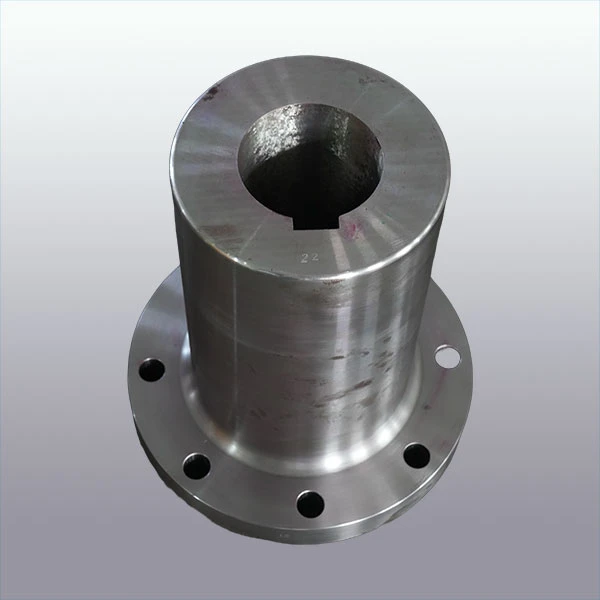
Key Advantages of Boat Shaft Couplings
- Corrosion-resistant and durable: Suitable for seawater and salt spray, with a lifespan of 5-8 years under normal maintenance, exceeding the lifespan of general couplings in humid environments.
- Vibration and shock absorption: Flexible elements cushion vibration and shock, reducing wear on bearing seals and minimizing failures.
- Shafting protection: Compensates for displacement, preventing shafting bending and base cracking caused by rigid connections, ensuring safe navigation.
- Easy maintenance: Select models feature disassembly and quick-change elastic components, eliminating the need to lift the main engine, making them suitable for emergency repairs.
FAQ
Q: What is a flexible coupling?
A: A flexible coupling is a transmission component that transmits torque and compensates for relative displacement between two shafts. Its core advantage is its ability to absorb vibration and cushion shock through flexible elements. Flexible couplings can accommodate displacement caused by installation errors, thermal expansion, or vibration, preventing equipment damage and offering a wide range of applications.
Q: How to choose the right Flexible Coupling for your equipment?
A: Four key parameters to consider:
- Torque capacity: Select a coupling that is 1.2-1.5 times the equipment's rated torque to prevent overload damage;
- Displacement compensation: Match the maximum radial, axial, and angular displacements of the two shafts;
- Speed: The coupling's allowable speed must be higher than the equipment's maximum operating speed to prevent centrifugal failure;
- Operating environment: Choose stainless steel for humid/corrosive environments, avoid ordinary rubber for high temperatures, and prioritize gap-free structures for dust-prone environments.
Q:How can I extend the life of my flexible coupling?
A: Keys to extending life:
- Ensure accurate installation alignment.
- Avoid prolonged overload operation.
- Perform regular maintenance based on operating conditions.
- Prevent corrosive media from direct contact with components.
Q:What is a Boat Shaft Coupling?
A: A Boat Shaft Coupling is a flexible coupling designed specifically for marine transmission systems. It connects the main engine and propeller shaft, transmitting torque while compensating for shaft misalignment. The main body is typically made of corrosion-resistant materials such as stainless steel, resistant to seawater and salt spray.
Q:How should I address abnormal vibration or noise during coupling operation?
A: Common Causes and Solutions:
- Excessive misalignment: Stop the machine and use a laser alignment tool for recalibration.
- Damaged flexible element: Replace the corresponding flexible element.
- Loose connection: Tighten bolts or repair keyways.
- Overload: Check if the equipment load exceeds the rated value. Reduce the load or replace a high-torque coupling.
Q:What coupling checks should be performed before restarting equipment after a long period of inactivity?
A: Common Causes and Solutions:
- Complete three checks before restarting:
- Clean the coupling surface from dust and oil, and inspect the main body for rust and cracks.
- Check the condition of the flexible element and regrease the universal coupling.
- Recalibrate the alignment of the two shafts to ensure that the deviation is within the allowable range.
We're professional coupling manufacturers and suppliers in China, specialized in providing high quality customized service. We warmly welcome you to buy high-grade coupling from our factory.